


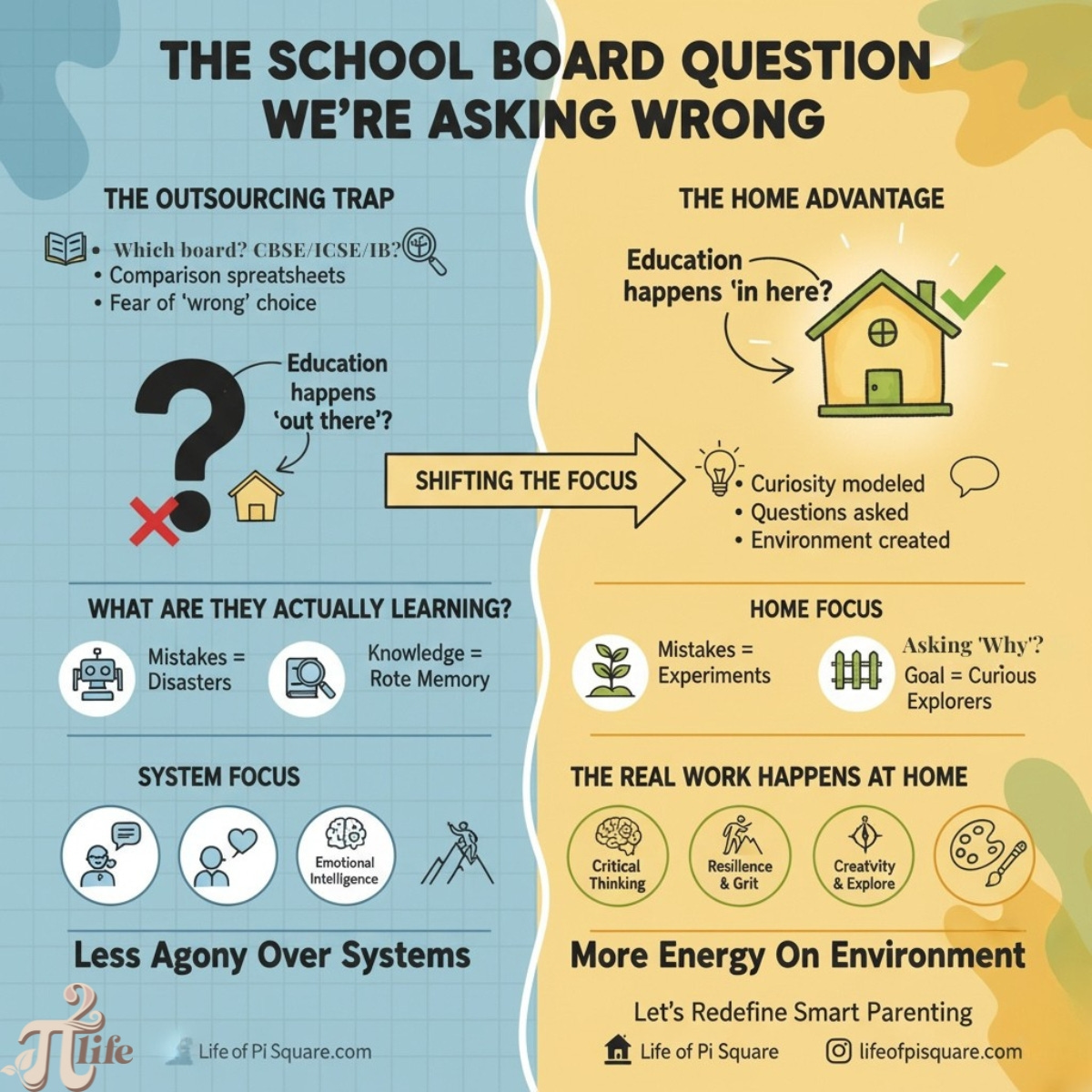
We’ve watched dozens of parents spiral into anxiety over which school board to choose. CBSE or ICSE? State board or International? The WhatsApp groups buzz with debates. The comparison spreadsheets grow longer. The fear of making the “wrong” choice keeps parents up at night.
But here’s what we’ve been thinking about lately: What if we’re asking the wrong question entirely?
The Outsourcing Trap
We’ve become a generation of parents who believe that education happens out there — in classrooms with the right curriculum, under the guidance of the right teachers, within the structure of the right board.
And yes, schools matter. But somewhere in our quest for the perfect institutional setup, we’ve forgotten something fundamental:
Children learn the most from their homes.
Not from textbooks. Not from the curriculum. But, from us - from the environment we create; the questions we ask; curiosity we model. From how we wonder and discover. From the way we respond not just when they fail, but also when we do.
What Are They Actually Learning?
Think about what your child is absorbing at home right now:
Are they learning that mistakes are disasters to be hidden or experiments to be explored?
Are they learning that knowledge comes from rote memorization or from asking “why” and “what if”?
Are they learning to be curious about the world or to be compliant students?
Are they expressing their emotions, or are they kicking, beating, and throwing a tantrum to express resentment, unhappiness, or discontentment?
Are they distinguishing emotions from communication, or are they all silent during negative emotions?
Are they learning problem solving, or are they waiting for someone to solve their problems?
These aren’t subjects you’ll find on any board’s curriculum. But they’re the lessons that will shape who your child becomes far more than whether they study from NCERT or Cambridge textbooks.
The System Isn’t Designed for Your Child
Here’s an uncomfortable truth: Every school board — no matter how prestigious — is designed to cater to the masses. It’s a system built for scale, for standardization, for managing large numbers of students.
It cannot, by its very nature, be customized to your child’s individual needs.
Your daughter who loves to draw but struggles with math? The system has a fixed ratio of art to math.
Your son who learns by taking things apart but can’t sit still for lectures? The system has predetermined modes of instruction.
Your child who asks deep philosophical questions at dinner but is blank during exams? The system has standardized assessment methods.
The board you choose won’t change this fundamental limitation.
The Real Work Happens at Home
So what can we do?
We can create homes where curiosity is celebrated. Where “I don’t know, let’s find out together” is a valid response. Where questions are more valued than right answers.
We can provide environments for exploration. We don’t need expensive educational toys or elaborate setups. Children explore with what they have — if we let them. A kitchen becomes a chemistry lab. A backyard becomes a biology lesson. A rainy day becomes a physics demonstration.
We can model lifelong learning. When did you last say “I don’t know” in front of your child and then genuinely try to learn something new? When did they last see you struggle with something and persist?
We can build emotional foundations. The ability to handle disappointment, to collaborate, to communicate feelings, and to recover from setbacks - these aren’t taught in any curriculum, but they’re learned every single day at home. We were pleasantly surprised one day when, during a disagreement, our 3-year-old showed us that there is space for expressing discontent without stopping communication.
Our 3 year old - “I’m unhappy with you but I’m talking to you”.
A Different Kind of Preparation
We’re not saying schools don’t matter. They do. Structures matter. Peer learning matters. Formal education matters.
But we are saying that we’ve been so busy optimizing for the system that we’ve forgotten to optimize for the child.
The most important preparation we can give our children isn’t found in choosing between boards. It’s found in:
Teaching them how to think, not what to think
Creating & enabling learning ecosystems instead of showing them what & how to learn
Harnessing their intrinsic motivation rather than dependency on external rewards
Developing their ability to pursue interests deeply rather than skim everything superficially.
Let them lead, and act only as a facilitator rather than a teacher.
So Which Board Should You Choose?
Choose the one that’s most convenient. Or most affordable. Or most aligned with where you think you might live in the future.
But then—and this is the important part—stop worrying about it.
Take all that energy you’re spending on school board research and redirect it toward:
When did I last follow my own curiosity in front of my child?
What happens when my child asks “why” for the fifth time - do I engage or dismiss?
Do my reactions to my own mistakes teach resilience or perfectionism?
Am I creating space for boredom or filling every moment with structured activity?
The Education That Matters Most
The school board will teach your child history dates and mathematical formulas and grammatical rules.
But you — in your home, through your daily interactions — you’re teaching them about life.
You’re teaching them whether the world is a place of wonder or worry.
You’re teaching them whether learning is joyful or just another thing to get right.
You’re teaching them whether curiosity leads to discovery or to being told to sit down and be quiet.
This is the education that will actually matter in their lives.
So yes, choose a school board. But please, stop agonizing over it.
Because the real question isn’t which system you’re enrolling them in.
It’s what kind of environment you’re creating for them at home.
What does learning look like in your home? What are you inadvertently teaching your children through your daily responses and reactions? We’d love to hear your thoughts in the comments.
💬 Let’s Redefine “Smart Parenting”
At Life of Pi Square, we believe that parenting is logical, and the smartest parents aren’t the ones using the latest apps.
They’re the ones who know when to pause and listen.
If this message resonates with you,
📬 Subscribe for more reflections on mindful, connected parenting in the digital age.
Follow our journey on Instagram @lifeofpisquare
and explore our approach to raising confident, independent kids at lifeofpisquare.com