


A Different Kind of Morning
It’s 7:30 AM in Helsinki, and eight-year-old Mikko is getting dressed. Not after three reminders. Not after negotiations. He simply wakes up, chooses his outfit, and gets ready.
His mother, Lisa, isn’t hovering. She’s making coffee. When Mikko comes to breakfast, they discuss whether he’ll walk to school alone today or bike with his older sister.
No bribes. No threats. This is just... Tuesday.
Meanwhile, 6000 kms away, another mother is already exhausted. She’s negotiated breakfast, laid out rejected clothes, and refereed two sibling fights. And school hasn’t even started yet.
What’s the difference?
The Question That’s Keeping You Up at Night
If you’re like most parents, you’ve spent countless hours researching schools. Which curriculum is best? Which teachers get results? CBSE, ICSE, IB, Alternate schooling, or Homeschooling?
You’ve toured buildings, scrutinized test scores, and joined Facebook groups where parents debate phonics programs like matters of national security.
Here’s what I learned after diving into Nordic parenting research: You’re asking the wrong question entirely.
The right question isn’t “Which school board will give my child the best education?”
It’s “What am I teaching my child right now, in this moment, at home?”
What Seven Years of Happiness Data Reveals
Finland tops the World Happiness Report year after year. Dig into the data, and something fascinating emerges: Finnish adults report that childhood experiences shaped their well-being more than any other factor.
Not their school achievements. Not test scores. Their childhood experiences. The environment their parents created at home.
The Three Questions Finnish Parents Ask Daily
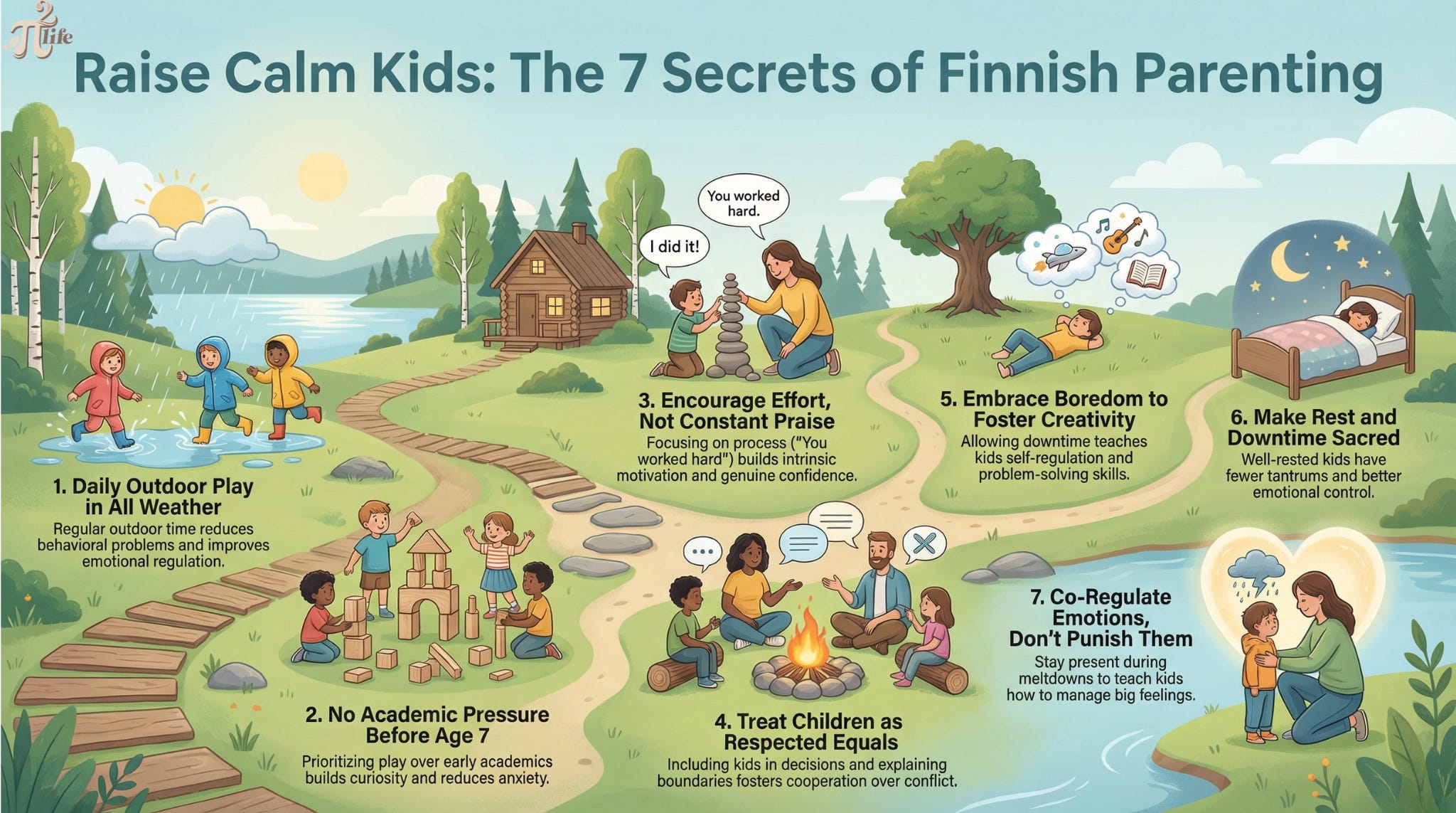
Question 1: “Has my child been outside today?”
Not “Did they finish their homework?” Not “Did they practice piano?” Just “Have they been outside?”
In Nordic culture: “There’s no such thing as bad weather, only bad clothing.” Children play outdoors for hours regardless of conditions. Rain means puddle jumping. Snow means sledding. Cold means layering up.
Movement and nature exposure regulate children’s nervous systems like nothing else can. A child who’s run, climbed, and explored is biologically calmer than one who’s been indoors all day.
Finnish parents see outdoor time as non-negotiable infrastructure for wellbeing—not a reward for good behavior or something that happens if there’s time left over.
Home teaches: Your body needs movement like it needs food and sleep.
Question 2: “Am I letting them struggle enough?”
This one flips conventional parenting on its head.
We help with homework. We intervene in conflicts. We smooth every rough edge before our children encounter it.
Finnish parents do the opposite. They create opportunities for productive struggle.
A five-year-old can’t zip their jacket? The parent waits. “That’s tricky. What could you try?” But they don’t rush in to solve it.
This isn’t neglect. It’s intentional skill-building. Children who regularly navigate age-appropriate challenges develop better executive function, emotional regulation, and problem-solving abilities.
Competence builds confidence. Confidence reduces anxiety. Less anxiety means calmer kids.
When children know they can handle things, they stop melting down over every difficulty.
Home teaches: You are capable of figuring things out.
Question 3: “Is my child accumulating enough boredom?”
Yes, you read that right. Accumulating boredom.
While many parents frantically schedule activities to prevent boredom, Finnish parents view unstructured time as essential nutrition for developing minds.
Summer vacation? Largely empty. Weekends? Minimal scheduled activities. After school? Free play, not tutoring.
The brain’s default mode network—responsible for creativity, self-reflection, and problem-solving—only activates during downtime. Constant stimulation starves this system.
Finnish children complain about being bored just like kids everywhere. The difference? Finnish parents respond with, “That’s good. Figure out what you want to do.” No suggestions. No entertainment. Just space.
Home teaches: You can create your own meaning and joy.
The Invisible Skills No Curriculum Can Teach
Schools can teach reading, math, and history. They cannot teach the three foundational capacities that determine life success:
Curiosity - The desire to explore and question independently
Resilience - The ability to face setbacks without falling apart
Joy - Finding satisfaction in the process, not just the outcome
These develop through environment and experience. Through how you respond when your child is frustrated. Through whether you solve their problems or let them struggle. Through whether learning happens under pressure or through play.
School boards are designed for the masses, not for your individual child’s emotional development. Only home can build these capacities.
What This Actually Looks Like
Finnish parents aren’t permissive. They have boundaries. The difference is in the how.
Natural consequences instead of rewards and punishments. A child refuses rain boots? They get wet feet and learn. No lecture. No “I told you so.” Experience teaches.
Observation instead of constant praise. Rather than “Good job!” after every action, they might say, “You spent a long time on that puzzle” or “You tried three different ways before it worked.” This builds intrinsic motivation rather than dependence on external validation.
Genuine dialogue instead of talking down. When a six-year-old asks why they can’t have ice cream for dinner, there’s no “Because I said so.” They explain nutrition, discuss balance, and might even ask the child what they think would happen.
Children who are reasoned with learn to reason. Children who are respected learn respect.
The Uncomfortable Truth
Most parenting advice focuses on behavioral control. How to get kids to listen. How to stop tantrums. How to enforce rules.
Finnish parents flip the script: Instead of controlling behavior, they build capacity.
The child who’s been outside, who’s well-rested, who’s allowed to struggle appropriately, who isn’t overscheduled or overpraised—this child simply has fewer meltdowns.
Not because they’re controlled better. Because their nervous system is regulated. Because they’ve developed genuine skills. Because they’re not chronically stressed.
It’s preventive rather than reactive.
The School Board Decision (Simplified)
Here’s the Finnish-inspired approach:
Pick a school that meets basic needs. Safe? Logistically reasonable? Aligns with core values? Good enough.
Stop obsessing over the rest. Curriculum differences between most schools are marginal. Your daily interactions matter exponentially more.
Invest your energy in what you control: The environment at home.
Are you creating space for outdoor play or filling every moment with structure?
Are you building intrinsic motivation or relying on treats and threats?
Are you letting your child struggle appropriately or solving everything?
Are you modeling calm regulation or anxiety?
These daily choices shape your child more than any school board decision ever will.
Starting Where You Are
You don’t need to move to Scandinavia. Start with one shift:
This week: The “outside first” rule. Before screen time, before homework - 30 minutes outside. Every day. Weather-proof your child with proper gear.
Watch what happens to evening meltdowns, sleep quality, and cooperation.
Next week: Practice the pause. When your child struggles with something they can handle, wait five seconds before helping. Then ask, “What do you think you could try?”
The week after: Schedule boredom. Block out Saturday afternoon with nothing planned. No suggestions. Just space.
These aren’t discipline techniques. They’re capacity-building practices.
What Really Matters
The daily environment you create teaches more powerfully than any curriculum.
Your child is learning right now from how you respond to their frustration. From whether you trust them with age-appropriate independence. From how you handle your own stress. From whether life at home feels like constant pressure or has room to breathe.
School boards can’t teach resilience, instill genuine curiosity, or create emotional regulation skills. Those things happen at home, in the seemingly small moments you’re probably not even thinking about.
So yes, choose a school. But then release the anxiety about whether it’s the “best” one.
The best education your child will receive doesn’t come from a building or curriculum. It comes from the environment you’re creating right now, today, at home.
That’s where calm kids come from. That’s where resilient humans are built. That’s where joy in learning is either kindled or extinguished.
And that’s entirely within your control.
The question isn’t which school board is best. The question is: What kind of environment am I creating at home? That’s the question worth losing sleep over. And ironically, once you answer it well, you’ll sleep better than you have in years.
💬 Let’s Redefine “Smart Parenting”
At Life of PI Square, we believe that parenting is logical, and the smartest parents aren’t the ones using the latest apps.
They’re the ones who know when to pause and listen.
If this message resonates with you,📬 Subscribe for more reflections on mindful, connected parenting in the digital age.
Follow our journey on Instagram @lifeofpisquare and explore our approach to raising confident, independent kids at lifeofpisquare.com